
Omniscope custom block · Connectors
What does each of our wallets hold, and what went in and out of it? Balances and complete transaction lists for a field of addresses, on Ethereum or another chain Etherscan serves.
Python · requests, pandas · requests installed on first run if missing
The problem it solves
An organisation that holds crypto assets, or a team that monitors addresses, keeps a list of wallets. Checking each one on a block explorer by hand is slow, and the explorer shows one address at a time, with amounts in wei and times as Unix seconds.
This block takes the list as a field, asks Etherscan's API about every address, and writes the balances or the full transaction history as records: amounts in ether, times as dates, every transaction of every wallet in one table.
- 5 invented wallets in the sample, one of them with no transactions at all
- 70 transactions loaded for them, 2 of which failed on chain (isError = 1)
- 10,000 transactions per call at most; the block keeps asking until it has every one
- 20 addresses per balance call, paced to the free plan's 3 calls a second
How it works
- Enter an Etherscan API key and choose the field of addresses.
- Choose Balances or Transactions; leave Chain ID at 1 for Ethereum.
- Values that are not addresses are skipped and counted in the block's message.
What goes in
Wallets
Five invented wallets with random addresses.
| Wallet | Address |
|---|---|
| Treasury | 0xeee65f53e9421ce50211670eae679f02e8d28a79 |
| Payroll | 0x023c39c200661fccd268a29a0d347301ef56e64d |
| Grants | 0xc3cd6089065c3146e80a9c222670bbe4f4c54977 |
| Event tickets | 0x656cf2d133187c8df95247f2866028de71159b42 |
| Cold storage | 0xb4ea410fb9102f29a422eb14ab2f2d0f0cc02223 |
The addresses are random; the demo uses invented Etherscan responses for them, so it runs without an API key.
The options
| Option | Demo setting | What it does |
|---|---|---|
| API key | (your key) | Your Etherscan API key, from https://etherscan.io/myapikey. |
| What to load | Transactions | Balances: one record per address. Transactions: one record per transaction. |
| Chain ID | 1 | 1 is Ethereum; other chains by their ID (8453 Base, 42161 Arbitrum One...). |
| Address field | Address | The field with the addresses. |
What comes out
Transactions (first 6, some fields)
| Account | Time | Amount | from | to | isError |
|---|---|---|---|---|---|
| 0xeee6…8a79 | 2025-01-07 14:41:14 | 0.0 | 0xeee6…8a79 | 0xe9ea…3a20 | 0 |
| 0xeee6…8a79 | 2025-01-14 09:11:26 | 2.3 | 0xeee6…8a79 | 0x8ec1…0071 | 0 |
| 0xeee6…8a79 | 2025-01-20 08:24:45 | 0.0 | 0xeee6…8a79 | 0x1ead…01c3 | 0 |
| 0xeee6…8a79 | 2025-01-25 08:24:51 | 0.0 | 0xeee6…8a79 | 0x6a88…0337 | 0 |
| 0xeee6…8a79 | 2025-01-30 11:11:30 | 2.3 | 0xe9ea…3a20 | 0xeee6…8a79 | 0 |
| 0xeee6…8a79 | 2025-02-01 07:42:15 | 1.7 | 0xf252…86d0 | 0xeee6…8a79 | 0 |
Addresses shortened here. 70 records in all, 23 fields. Amount is in ether; transactions with Amount 0 are contract calls (here, token transfers). Time is in UTC.
Per wallet (Aggregate on Account, joined to the wallet names)
| Wallet | Transactions | Ether moved |
|---|---|---|
| Treasury | 31 | 47.63 |
| Payroll | 24 | 26.18 |
| Grants | 12 | 10.02 |
| Cold storage | 3 | 0.00 |
Event tickets has no transactions, so it has no records. With Balances instead, the same five wallets give five records, from 0 (Event tickets) to 902.5 ether (Cold storage).
Where it pays off
Finance teams: Crypto holdings at month end
Balances of every company wallet on the reporting date, in ether, next to the price feed and the ledger.
Audit and compliance: Transaction trail
Every transaction in and out of a set of addresses, with time, counterparty, amount and whether it failed, ready to filter and sample.
Treasury operations: Flows between wallets
Which wallets pay which, how much, and how often: aggregate on from and to, or join the output to itself.
Analysts: Activity of known addresses
Track a list of exchange, fund or project addresses over time, on Ethereum or another chain by chain ID.
Use cases describe typical scenarios and are illustrative; the sample data is invented.
Why do this in Omniscope
- Wallet names, ledgers and prices in the same workflow. The output joins on Account to your own list of wallets and on Time to a price table, so holdings in pounds or dollars go straight into the Report, which the explorer's address page cannot do.
- A month-end check that repeats itself. Scheduled, the block reloads every transaction of every wallet, past the 10,000-a-call limit, so the totals are rebuilt from the full history each time; a wallet balance under a threshold can halt the run through Validate data.
- Other calls in the same script. Internal transactions and token transfers are the same kind of Etherscan call with a different action; the request code is a short function in the block's Python script, open in the block editor.
How it fits into an Omniscope workflow
Wallet list (File or Database) → Etherscan → Join (back to the wallet list on Account) → Aggregate or Formula → Report
For balances in another currency, join the Balances output to a price table, or the Transactions output by date. A Record filter on isError = 1 lists the failed transactions.
Try it
- Open the demo project (
demo.ioxon the demo server, or importdemo.iozfrom this folder). It holds the wallet list, the Etherscan block without a key, and a File block withplaceholder.csv: the 70 transactions the block writes for the invented responses. - The question: how much ether has each wallet moved, and which transactions failed?
- Follow the File block into the rest of the workflow: transactions and ether moved per wallet.
- To use real data: enter your API key in the Etherscan block, put your own addresses in the wallet list, run it, and connect its Results output where the File block was.
Running in Omniscope
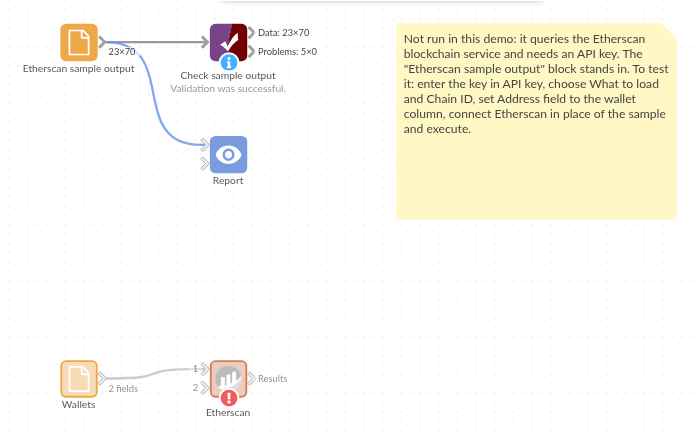
The demo project's workflow: the wallet list, the block, the placeholder data and a Validate data check.
Language and libraries
Python. It uses requests (Apache License 2.0) and pandas (BSD 3-Clause).
pandas is part of Omniscope's Python environment. requests is listed in the block's dependencies, so Omniscope installs it with pip on first run if it is missing.
Tested
The block is covered by automated tests that run its script against a stand-in for Omniscope's Python API and invented Etherscan responses (no live calls): balances and transactions of the sample, the requests sent (API version 2, chain ID, batches of 20), another chain, values that are not addresses, a refused key, the rate limit, an HTTP error (the key is not shown), 23,456 transactions for one address read past the 10,000-a-call limit, empty input, and wrong field types.