
Omniscope custom block · Connectors
Someone has already written the SQL for the on-chain figure you need. Load any saved Dune query's result, every row, with numbers and dates ready to use, on demand or freshly executed.
Python · requests, pandas · requests installed on first run if missing
The problem it solves
Blockchain activity is public, but turning it into tables takes a data warehouse of decoded chain data and the SQL to query it. Dune has both, and its users publish many ready-made queries: trading volumes, token holders, protocol revenue.
This block brings one saved query's result into an Omniscope workflow: either the stored result of its last run, or a new run started and waited for. It reads every page and types the columns, so dates are dates and amounts are numbers.
- 120 rows in the sample result: 30 days for 4 chains, read in 3 pages
- 8 columns: a date, whole numbers, decimals, true/false, a 256-bit amount kept as text, and a list kept as JSON
- 1 missing value (one day's volume on one chain) left empty, not zero
- 1 record in the Execution output saying when the result was computed and when it expires
How it works
- Enter your Dune API key and the query's ID (or paste its address).
- Retrieve reads the last stored result; Execute runs the query now and waits.
- The Results output has the rows; the Execution output says which run they came from.
What goes in
Nothing from the workflow: the block reads from Dune. The demo uses an invented result for an invented query, "daily DEX trades by chain" (query ID 4100217), so it runs without an API key; sample-data/placeholder.csv holds the Results output for it.
The options
| Option | Demo setting | What it does |
|---|---|---|
| Dune API key | (your key) | An API key from your Dune account's API settings. |
| Query ID | 4100217 |
The query's number, or its address on dune.com. |
| Query mode | Retrieve latest query results | Retrieve the stored result, or Execute the query now. |
| Engine size | Medium | Execute only: Small, Medium or Large. |
What comes out
Results (first 6)
| day | chain | trades | volume_usd | is_weekend | top_pair | largest_trade_wei | venues |
|---|---|---|---|---|---|---|---|
| 2026-09-01 | ethereum | 94,277 | 241,530,218.14 | false | WETH-USDT | 72639847596670492302325 | ["aerodrome", "uniswap"] |
| 2026-09-01 | arbitrum | 81,435 | 250,196,476.99 | false | WETH-USDT | 36409462060795354744388 | ["curve", "sushiswap"] |
| 2026-09-01 | base | 101,212 | 260,062,577.55 | false | WETH-USDT | 23760718497346144041002 | ["curve", "aerodrome"] |
| 2026-09-01 | polygon | 46,228 | 117,070,269.39 | false | WETH-USDC | 10680431344000245538648 | ["curve", "uniswap"] |
| 2026-09-02 | ethereum | 98,076 | 180,794,911.95 | false | WETH-USDT | 59584623668896598024783 | ["sushiswap", "aerodrome"] |
| 2026-09-02 | arbitrum | 86,581 | 225,774,981.94 | false | WETH-USDC | 15727244418416956499933 | ["uniswap", "curve"] |
120 records in all. day is a date (UTC), trades a whole number, volume_usd a decimal, is_weekend true/false.
Per chain (Aggregate on chain)
| chain | Days | Trades | Average trades, weekdays | Average trades, weekends |
|---|---|---|---|---|
| ethereum | 30 | 3,013,246 | 107,992 | 79,678 |
| base | 30 | 2,794,356 | 100,953 | 71,673 |
| arbitrum | 30 | 2,186,632 | 79,011 | 56,048 |
| polygon | 30 | 1,097,957 | 39,141 | 29,607 |
Execution
| Execution ID | Query ID | State | Ended | Expires | Rows |
|---|---|---|---|---|---|
| 01K9ZQ4T7W2R8M5H3XJ6D1VYCE | 4100217 | QUERY_STATE_COMPLETED | 2026-10-01 06:00:41 | 2026-12-30 06:00:41 | 120 |
Where it pays off
Crypto funds and treasuries: Market activity next to positions
Daily volumes, prices or holder counts from published Dune queries, joined to your own holdings and trades.
Protocol teams: Usage reporting
Your own Dune queries on your protocol's contracts, executed on a schedule and published as a report for the team or the community.
Research: On-chain indicators
Load several queries' results and compare chains, tokens or venues over time, with dates and amounts typed for charting.
Compliance: Evidence of a figure
The Execution output records which run a number came from and when it was computed, alongside the number itself.
Use cases describe typical scenarios and are illustrative; the sample data is invented.
Why do this in Omniscope
- Dune's figures beside your own. The result is ordinary Omniscope records, so it joins to your positions, prices or customer data in the same workflow and feeds the Report's charts and filters directly.
- A fresh result on a schedule, checked. In Execute mode a scheduled run computes the query anew each time and waits for it; Validate data on the Results output stops the run if a day is missing or a total falls outside the expected range.
- Typed by Dune's own column types. Dates, whole numbers, decimals and true/false come out as such from the column types Dune reports, and the mapping is a short function in the block's Python script that you can change in the block editor.
How it fits into an Omniscope workflow
Dune (Results) → Aggregate or Formula → Join (your own data) → Report
Use the Execution output to show in the Report when the figures were computed, or in a Validate data block to check that the result is recent.
Try it
- Open the demo project (
demo.ioxon the demo server, or importdemo.iozfrom this folder). It holds the Dune block without a key, and a File block withplaceholder.csv: the 120 rows the block writes for the invented result. - The question: which chain trades most, and how much quieter are weekends?
- Follow the File block into the rest of the workflow: trades per chain, weekdays against weekends.
- To use real data: enter your API key and a query ID in the Dune block, run it, and connect its Results output where the File block was.
Running in Omniscope
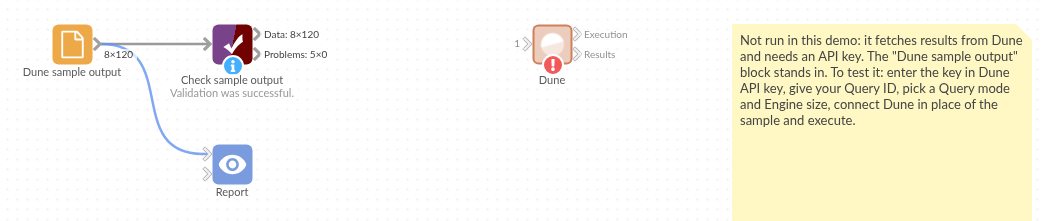
The demo project's workflow: the placeholder data, the block, and a Validate data check on the output.
Language and libraries
Python. It uses requests (Apache License 2.0) and pandas (BSD 3-Clause).
pandas is part of Omniscope's Python environment. requests is listed in the block's dependencies, so Omniscope installs it with pip on first run if it is missing.
Tested
The block is covered by automated tests that run its script against a stand-in for Omniscope's Python API and an invented Dune result served in pages (no live calls): the latest result read across pages, the requests sent, the Execution record, an execution waited for, the engine size, failed, cancelled and expired executions, a partial result, a query ID given as an address, a refused key and a missing stored result, an empty result, unexpected values in typed columns, and 100,000 rows.